How Much Can You Really Earn with a Battery on Estonia’s Flexibility Markets?
A real-world case study of the economics of a 1 MW / 2 MWh BESS project on the mFRR market in Estonia
The opportunities to earn revenue by helping keep the electricity system stable are substantial, but the landscape is full of complex obstacles. Network tariffs, technical market rules, and dense energy-sector terminology can be overwhelming at first glance.
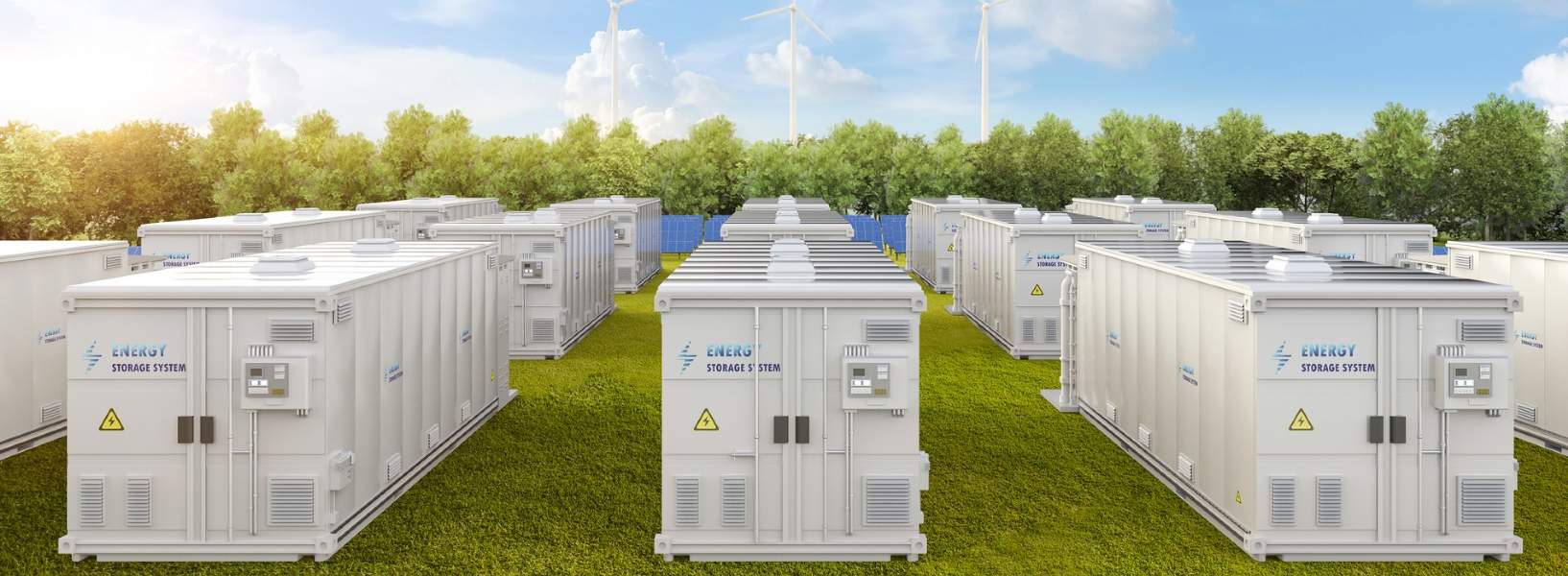
This article is a simple and clear guide into the world of a 1 MW / 2 MWh battery energy storage system (BESS). We strip away unnecessary complexity to show exactly what it costs to get started, what the monthly operating costs look like, and how to enter the lucrative but demanding mFRR market.
First things first. The total investment required to build the battery is approximately €440,000. The largest share of this comes from the battery cells and inverters, estimated at €300,000. A medium-voltage transformer adds around €50,000, while installation costs, calculated at €20,000 per MWh, amount to €40,000 for a 2 MWh system. The grid connection is assumed to cost roughly €50,000, but this applies only if there is available capacity in the local network. If the connection area is already congested, reinforcing the grid can become a lengthy and expensive process, potentially making the entire project economically questionable.
In this example, the battery operates exclusively on the mFRR energy market, where participants are paid both for delivered energy and for the mFRR bids. It is assumed the battery charges and discharges only according to mFRR activations, or with imbalance energy when necessary. The battery is assumed to be activated around 50% of the time, corresponding to roughly 1,440 fifteen-minute activations per month. It is also assumed that the battery follows system operator commands with an average accuracy of ±5%, which is typical for a well-controlled BESS. Revenues and costs are based on average prices from December 2025, where Volton’s activated offers had an average UP price of 123 €/MWh and DOWN price of €3/MWh. The average day-ahead market price was 74 €/MWh, and the average imbalance energy price was 66 €/MWh.
It is further assumed that the actual energy recorded at the grid metering point represents about 60% of the energy accounted for on the regulation market, because regulation energy is based on changes in power relative to a baseline, rather than always reflecting physical energy flows into or out of the grid.
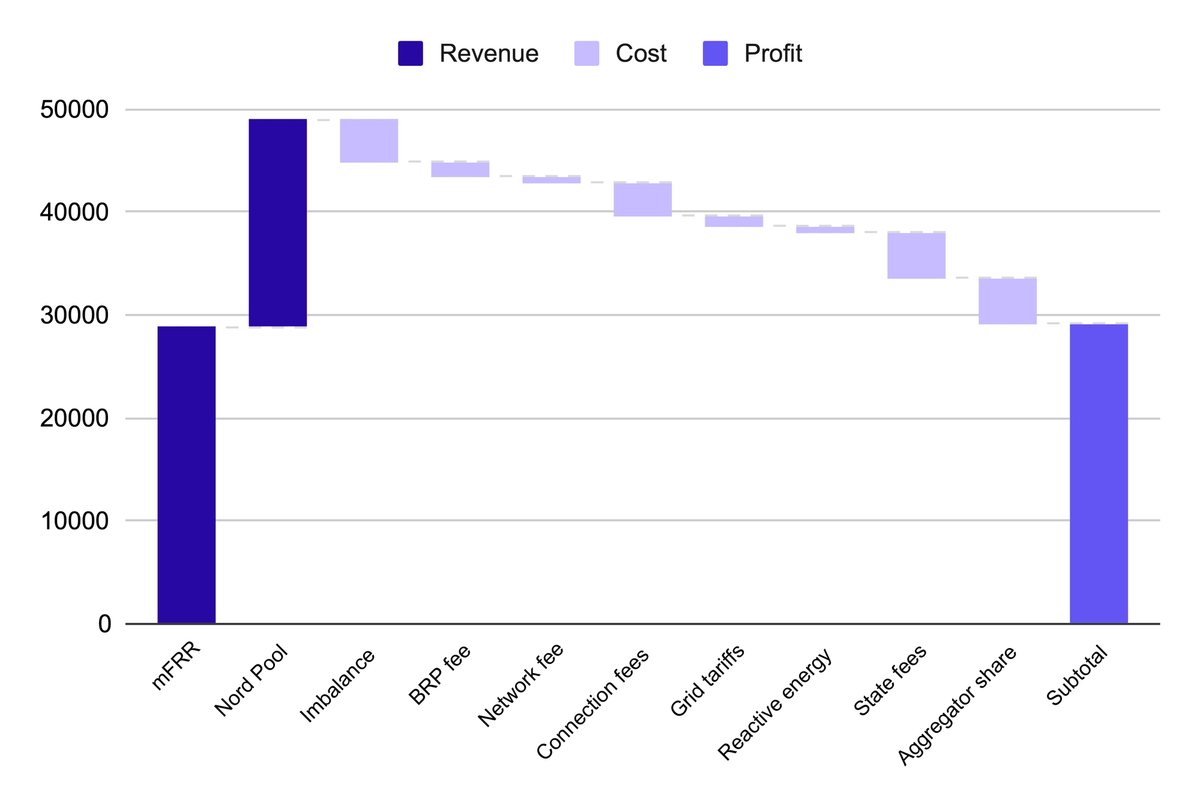
On the revenue side, the battery earns approximately €29,000 per month from mFRR activations. In addition, it earns around €20,000 per month from actually delivered energy, bringing total monthly revenue to €49,000. In rare cases, such as large frequency deviations combined with high winter electricity prices, monthly revenue can reach up to €80,000.
On the cost side, several system and network charges must be taken into account. The cost of imbalance energy paid to the balance responsible party is estimated at €4,200 per month. In addition, the Balance Responsible Party of the BESS charges a margin of €4 per delivered MWh, amounting to approximately €1,300 per month. The Elektrilevi network package fee is €800 per month, with additional charges for contracted connection capacity, €2,600, and transfer capacity, €600. Under the new net-based calculation rules, grid tariffs amount to €900 per month, while the renewable energy fee adds €1,000. Reactive energy costs are estimated at €600, the balancing capacity fee at €1,200, the security of supply fee at €1,700, and the electricity excise tax at €500.
In addition, the project must account for the fee charged by the aggregator or balancing service provider, which typically ranges from 5% to 30%, depending on the provider. Volton’s standard margin is 10%, calculated on total revenue after deducting imbalance costs. In this example, that corresponds to approximately €4,480 per month.
When all revenues and costs are combined, a clear picture emerges. Total monthly revenue is €49,000, while all fixed and variable costs — including imbalance costs, service provider fees, network charges, taxes, and the aggregator margin — sum to approximately €19,880 per month. This results in a net profit of around €29,000 per month for the battery.
On an annual basis, this monthly cash flow translates into approximately €335,000 in net profit, assuming market conditions and activation patterns remain similar to those observed in December 2025. Compared to the initial investment of roughly €440,000, the result is striking: the payback period is just under 1.5 years, on the order of 15-16 months, and the annual ROI is approximately 75%.
It is important to stress that this example does not rely on maximum theoretical revenues or extreme price spikes, but on Volton’s own confirmed results from December. It also excludes additional optimisation strategies and revenue streams beyond mFRR that could further increase returns in the future. These numbers help explain why battery projects in Estonia currently resemble a modern gold rush – an opportunity to generate significant cash flow in a short time with relatively compact physical infrastructure. At the same time, this remains a market- and regulation-driven business: prices, activation patterns, network fees, and market rules can and do change. Every battery project is therefore a balance between the promise of fast payback and long-term regulatory and market risk, requiring not only favourable initial conditions but also the ability to adapt over time.
If building a battery or participating in the energy markets interests you, you don’t have to navigate this complexity alone. Volton is your partner in providing balancing services, helping batteries and other flexible assets realise their full potential on the frequency markets.
Our goal is to make the complex energy world clear, transparent, and profitable. If you want to understand what your project can truly earn, feel free to get in touch with Volton – let’s explore together how to put your energy asset to work in the most effective way.
Date
01/20/2026